10 Ancient Sites in Athens Everyone Should Visit
Athens is one of the world’s most fascinating cities. The cradle of Western civilization and the birthplace of democracy is home to an impressive collection of ancient sites.
Everyone has heard of the Acropolis. This imposing landmark sits high on a hill overlooking the city. The Odeon of Herodes Atticus and the ancient Agora are right next to it. But that’s not all.
Walking through the streets of Athens, you’ll stumble upon an ancient cemetery, a library, a triumphal arch, more temples, and even a stadium. They all bear testament to the city’s impressive history.

The Acropolis
The Acropolis, or the high city of ancient Athens, was originally a refuge and a royal residence. Over time, it became one of the most important religious sites in the ancient world and a symbol of Greek architecture.
In the 5th century BC, the Parthenon, dedicated to the goddess Athena, was built. The Erechtheion, the Temple of Athena Nike, and the Propylaea date from the same period.
As Athens, and the rest of Greece, changed hands, the Acropolis was used as a church, a mosque, and even a military fortress where gunpowder was stored.
In 1687, during a Venetian siege, the gunpowder exploded, destroying a large portion of the Parthenon. In the early 19th century, the British took parts of the Parthenon to London.

Odeon of Herodes Atticus
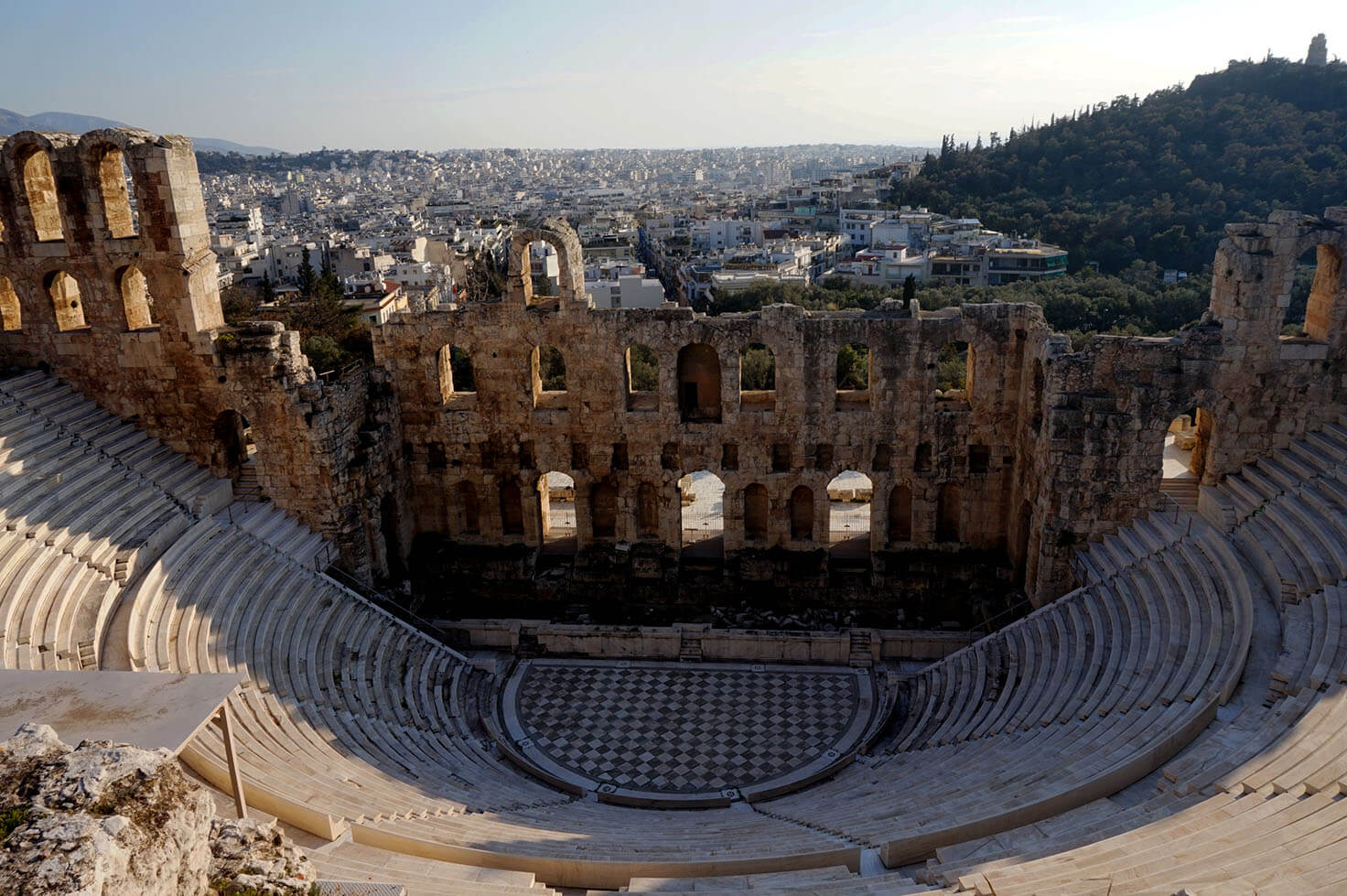
Right next to the Acropolis, on its southwestern slope, the Odeon of Herodes Atticus was one of the most important theaters in ancient Athens. It was built in 161 AD by a wealthy Athenian who dedicated it to his wife.
Originally, the stone theater was covered with a timber roof and could accommodate 5,000 spectators seated on marble benches. It was damaged in the 3rd century AD and left in ruins for centuries.
Today, the Odeon is open for cultural events, including the famous Athens and Epidaurus Festival, which takes place here (and at the Ancient Theater of Epidaurus) every summer.
The Agora
If the Acropolis was the high city, the Agora was its low city. It was the city’s main marketplace, a gathering place, and the center of political, commercial, social, and cultural life.
The Agora was established in the 6th century BC, but it flourished a century later, during the golden age of Athenian democracy. Its most famous monument, the Temple of Hephaestus, dates from that period.
The impressive colonnaded Stoa of Attalos is a reconstruction from the 1950s. It houses the Museum of the Ancient Agora. Although not ancient, the Byzantine Church of the Holy Apostles is also worth visiting.

Kerameikos
Northwest of the Agora, there is another impressive site you shouldn’t miss. Ancient Kerameikos was a potters’ quarter and the city’s main cemetery.
The area around Kerameikos has been used as a cemetery since the 12th century BC. In the 5th century BC, Themistocles built a city wall around Athens, and part of it is still on display in Kerameikos.
The entire site is open to the public. You will mostly see replicas of ancient funerary monuments, while the original pieces are kept inside the small museum on the site.

Hadrian’s Library
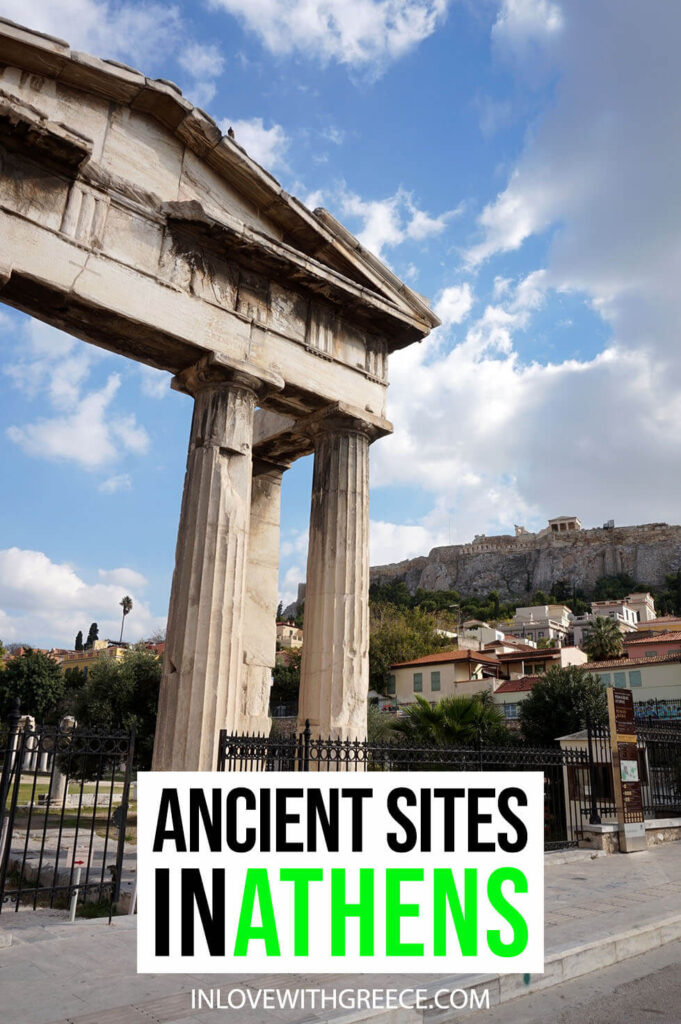
The Library of Hadrian was built in 132 AD by the Roman emperor Hadrian, who was a great admirer of Greek culture. It is located between the Acropolis and the Agora, right next to Monastiraki Square.
The site was more than just a library. It also served as a learning center and a cultural meeting place. In the 5th century, it housed a church. Some of the ancient stones were later used in the construction of the neighboring Tzistarakis Mosque.
Today, only a few of the original structures still exist, including the imposing western façade with its tall columns, the foundations of the courtyard and pool, and the remains of the reading and lecture rooms.

Roman Forum of Athens
The Roman Forum of Athens was the city’s agora during Roman times. It was built in the late 1st century BC with donations from Julius Caesar and Augustus, and it was connected to the Greek Agora and Hadrian’s Library.
The forum consists of a rectangular open courtyard surrounded by colonnades, where shops and storerooms were located, and a monumental gate dedicated to Athena.
Another structure that stands out is the Tower of the Winds, an octagonal marble clock tower. To its north, we find the city’s second mosque, Fethiye.

Lysicrates Monument
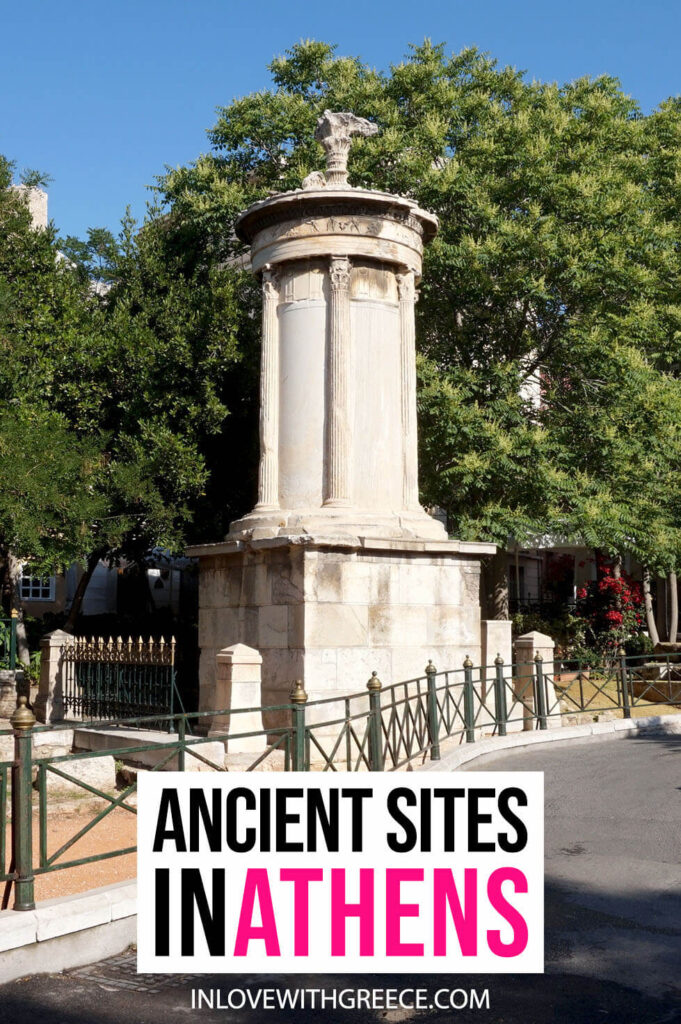
Few ancient sites are as nicely incorporated into the urban fabric as the Monument of Lysicrates. The monument is the centerpiece of a small square in one of Athens’ most beautiful neighborhoods, Plaka.
The wealthy Athenian Lysicrates commissioned the monument for the winning chorus at the Dionysus Festival in 335–334 BC. It is a cylindrical marble structure standing on a square base.
The six columns attached to the structure are thought to be among the earliest examples of Corinthian columns used on an exterior. Originally, the monument was topped by a bronze tripod awarded to the winners.

Temple of Olympian Zeus
The Temple of Olympian Zeus was one of the largest temples in the ancient world. Its construction began in the 6th century BC, continued in the 2nd century BC, and was finally completed under the Roman emperor Hadrian in 131–132 AD.
The original temple included 104 columns arranged in double and triple rows. Of those, only 15 still stand, while one lies horizontally on the ground.
At its northwestern corner, the large Arch of Hadrian marks the former boundary between the old city of Theseus and the new city of Hadrian.

Panathenaic Stadium
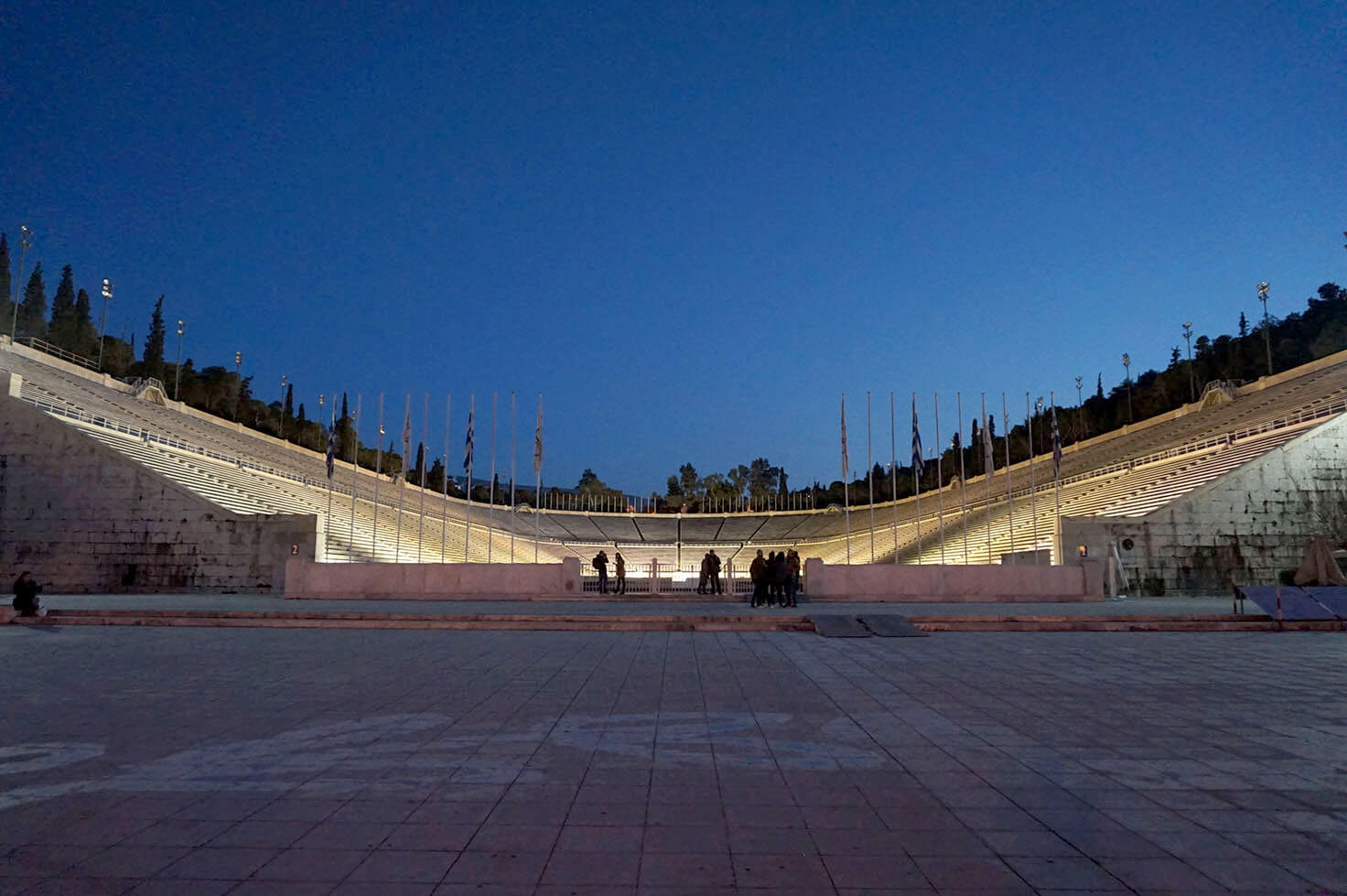
The Panathenaic Stadium, also known as Kallimarmaro (meaning beautiful marble), is a horseshoe-shaped stadium that can accommodate close to 50,000 spectators.
Originally built in the 4th century BC for the Panathenaic Games, it was reconstructed in marble by Herodes Atticus in the 2nd century AD. It was eventually abandoned and remained in ruins for centuries.
The stadium was completely reconstructed for the first modern Olympic Games in 1896. It remains the only stadium in the world built entirely of marble.
Philopappos Monument
We end our list with an imposing structure southwest of the Acropolis. The Philopappos Monument is a marble funerary monument on top of Philopappos Hill.
Built between 114 and 116 AD, it was dedicated to Gaius Julius Antiochus Epiphanes Philopappos, a prince of the Kingdom of Commagene, a prominent Athenian citizen, and a Roman consul.
It is a concave marble structure with sculpted reliefs and niches containing statues. Only part of the original monument still stands. The surrounding hill offers some of the best views of Athens.