10 Archaeological Sites in Greece You Must Visit
We have to be honest: we are archaeology queens. That’s one of the reasons why we love traveling around Greece. The country boasts some of the best archaeological remains in the world. Everywhere we go we find outstanding structures!
Now, being completely honest, some remains are super basic with hardly anything interesting to see. That’s why we want you to focus on the best ones. We have prepared the following post with our favorite 10 archaeological sites in Greece. Trust us, you have to see them. We are sure you fall in love with Greece!

The Acropolis and Other Ancient Sites of Athens
We moved to Athens several years ago and still find ourselves in awe at the city’s majestic archaeological remains. Evidently, the Acropolis takes the number one spot. We live a couple of blocks from it and admire it every day.
The incredible Agora is next. It combines Greek and Roman architecture beautifully. The ancient cemetery of Kerameikos is nearby. The other major beauty you must see is the Temple of Olympian Zeus with its massive columns.

Sanctuary of Delphi
We love the Sanctuary of Delphi because it blends archaeology and nature majestically. The sanctuary is on a slope of a hill overlooking the sea and beyond. The views from there are as grand as the archaeological remains.
Not only that, but Delphi is part of the world’s culture! Who hasn’t heard of its ancient oracle? Besides, it’s very easy to go from Athens to Delphi. Though you can go and return on the same day, we strongly recommend spending at least one night there.

Temple of Poseidon in Sounion
Granted, the remains of the Temple of Poseidon are not as grand as the two previous ones. However, they crown a hill on a gorgeous bay. Nothing beats looking at splendid Greek pillars from the sea.
Again, Sounion is pretty close to Athens and spending at least one night there is mandatory. Once you check out the entire compound, head to the beach below. Whether in winter or summer, the views of the temple on top of the hill will take your breath away.

Mycenae
Now we are taking you to the Peloponnese. If you think the above mentioned remains are old, wait till you see Mycenae. The remains date back to the 12th Century BC! Homer himself called it the golden city in his Iliad.
The place is quite big. Some structures like the tombs, some walls, and the Lion Gate are in great shape. It’s not hard to imagine the city’s former glory. The onsite museum is pretty cool too. You need at least a couple of hours to tour the entire area.

Ancient Theatre of Epidaurus
No matter how many theatres you’ve seen in your life, the Ancient Theatre of Epidaurus is in a league of its own. The theatre is also in the Peloponnese, just 25 miles (40 km) from Mycenae. When it comes to acoustics and design, experts consider it the best in the world.
You have to see the entire compound, including the sanctuary dedicated to the Greek God of Medicine, Epidaurus. From May to October, the Athens Epidaurus Festival takes over the theatre and the Odeon Atticus theatre in Athens. Watching and listening to a performance in Epidaurus is an experience you will never forget in your life.

Ancient Olympia
We are still in the Peloponnese, next to the western coast. The archaeological remains of Ancient Olympia are stunning! It’s the birthplace of the Olympics, over 700 years BC. It’s a big place, where you can walk for hours.
You have to see the temple of Zeus, the Temple of Hera, the Treasury Houses, the Palestra and the Gymnasium. The onsite museum is one of the best in the country. It’s famous for its sculptures and reliefs. Our favorite is the delicate sculpture of Nike, the Greek goddess of Victory.

Minoan Palace of Knossos
Crete is our favorite Greek island. It has splendid beaches, gorges, hills, valleys and one of the greatest archaeological remains in the world. The Minoan Palace of Knossos will take your breath away. Not only that, but it’s the oldest city in Europe.
The area is pretty close to Heraklion. It crowns a hill. Thus the fantastic views. Knossos is related to the Minotaur. To fully appreciate Knossos, you have to see the Archaeological Museum of Heraklion, one of the best in the world.

Island of Delos
Mykonos is famous for its beaches, glitzy nightlife, and fancy resorts. We think it should be famous for the island in front: Delos. The island has nothing but incredible archaeological remains. To get there, take a short boat ride from central Mykonos.
You have to see the onsite museum with its superb Charioteer statue and the Sphinx of Naxos. The 600 BC terrace of Lyons face the birthplace of Apollo! Walking about Delos is like traveling back in time. You can feel the greatness of Greek civilization.

The Acropolis of Lindos
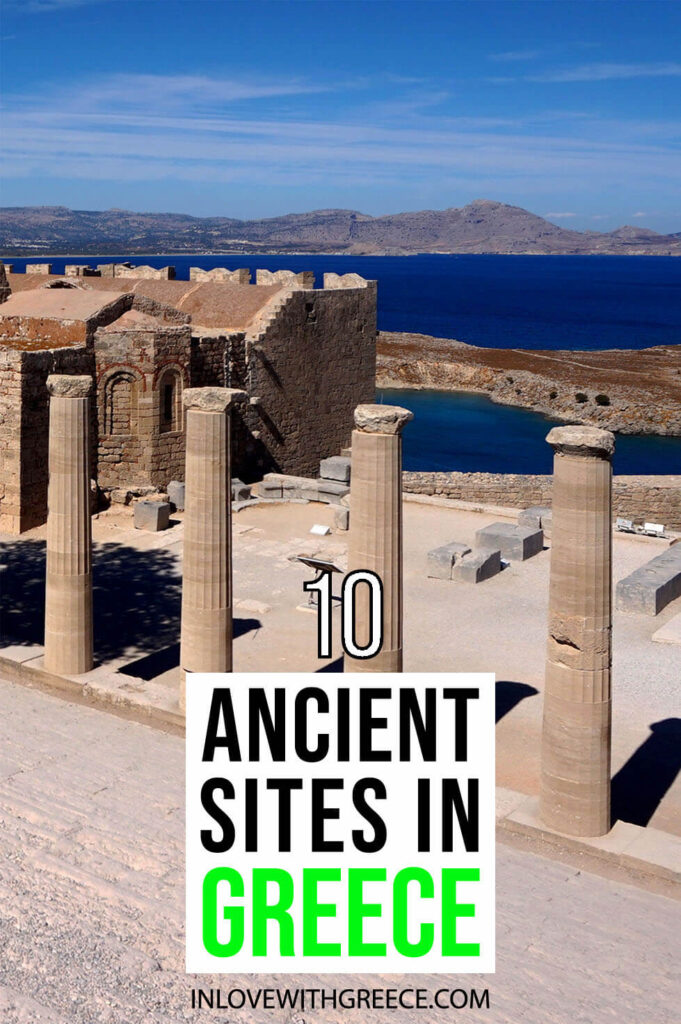
We have to be honest: we visited Rhodes to see its superb old city but weren’t expecting much of Lindos. We were so wrong! The Acropolis of Lindos blew our minds away. It crowns a hill overlooking Lindos town, some 30 miles (50 km) south of Rhodes city.
It’s a stiff climb up the ruins but your effort will be rewarded with jaw dropping views and delightful archaeology. You have Greek and Roman ruins, a fairy tale byzantine fortress, and an elegant orthodox church to discover. If you can, spend at least one night in Lindos town.

Akrotiri of Thera (Santorini)
Santorini is probably Greece’s most famous and popular island. And for good reason. The island is picture perfect and boasts stunning beaches, cute little towns, a one of a kind caldera, and the superb Akrotiri.
The remains date back 4000 years. A volcanic eruption covered them for ages, so they are in relatively good shape. The entire area is covered and you have 3 levels to explore. Don’t forget to check the Archaeological Museum of Prehistoric Thera in Fira. It’s got fascinating frescoes and golden sculptures from Akrotiri.