Guide to the Cycladic Architecture
If there’s one image that most of us associate with Greece, it’s that of a whitewashed village on a Cycladic island. The unique architecture of these stunning islands is one of the reasons why we fell in love with Greece.
Everybody knows Santorini and Mykonos. They are among the most popular Greek islands. However, there are 22 other inhabited islands in the Cyclades, each with a similar yet distinct appearance.
From ancient temples to whitewashed houses, churches, and windmills, Cycladic architecture is the epitome of simplicity and sustainability.

Ancient Sites
According to archaeological findings, the Cyclades have been inhabited since 5000 BC. Naxos, the largest island in the archipelago, has been continuously inhabited ever since.
In ancient times, Delos was the most important island in Greece. It served as a major religious sanctuary and later as a commercial hub. In fact, the term Cyclades, meaning Circle, refers to the group of islands forming a circle around Delos.
Akrotiri on Santorini is another important archaeological site. This thriving Bronze Age settlement was destroyed by a volcanic eruption and buried under ash in the 16th century BC.

Houses
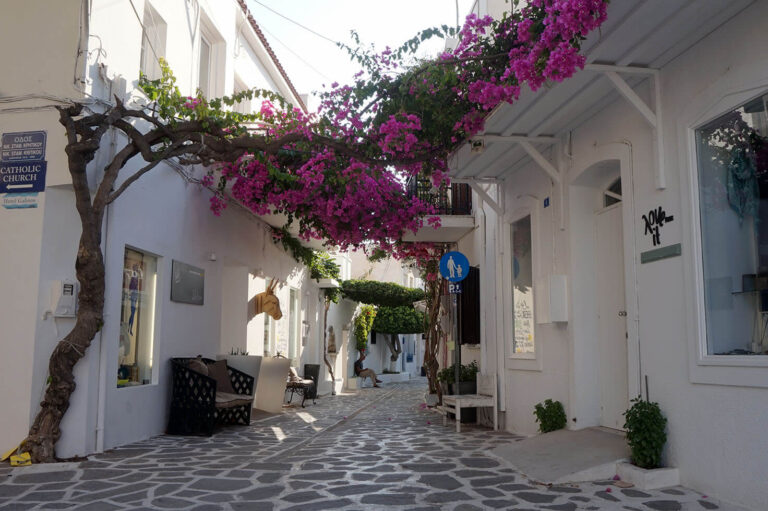
The beautiful Cycladic houses are what gave these islands their distinctive identity. They are usually square-shaped, with flat roofs designed to reflect sunlight and collect rainwater.
Most houses feature thick walls and small window openings, helping protect interiors from the relentless summer heat. The white color traditionally comes from limewash, which reflects sunlight and also acts as a disinfectant.
Many Cycladic towns were built within fortified settlements to protect residents from pirate attacks. These fortified quarters are known as Kastro, and you can find them on islands such as Sifnos, Serifos, Naxos, and Mykonos.

Churches
All inhabited Cycladic islands are home to hundreds of churches from different historical periods. Many were built by local fishermen either as offerings or as beacons to aid navigation.
Just like the houses, most churches are painted white to keep them cool under the intense sun. Since the region is highly earthquake-prone, the extensive use of arches and domes helps distribute structural weight more evenly.
Most temples belong to the Greek Orthodox Church, although there are also Catholic churches, particularly on the islands of Syros and Santorini. Our Lady of Tinos is the most important church in the archipelago.

Windmills
Another structure most people associate with the Cyclades is the iconic windmill. These windmills were introduced by the Venetians in the 16th century to mill wheat by harnessing the strong year-round Meltemi winds.
A typical windmill is a three-story circular structure made of stone and painted white. Its pointed roof is covered with wood, while the wooden sail was traditionally covered with cotton canvas.
You can find windmills on most Cycladic islands. The most famous group, known as Kato Mili, stands on a small hill right next to Mykonos Town.

Pigeon Houses
Pigeon houses, or dovecotes, were introduced to the islands by the Venetians in the 13th century. They bred pigeons for food and used their droppings as fertilizer.
These are usually two-story buildings, with storage spaces on the ground floor and nesting areas for birds above. They are whitewashed cubic structures decorated with intricate openings shaped like circles, triangles, or rhombuses.
Most pigeon houses are located on Tinos. The best place to see them is the village of Tarampados in the island’s interior. There are also dovecotes on Sifnos, Andros, and Mykonos.

Santorini
Santorini is unique for several reasons. It boasts the most dramatic volcanic landscape in the Cyclades, as well as some of the archipelago’s most picturesque villages and towns.
Because of the rugged terrain, many homes on Santorini are cave houses partially carved into the rock. This design helps preserve warmth in winter and coolness in summer. Unlike on many other islands, most houses here have curved, rather than flat, roofs.
Most churches on Santorini are white, although some are painted yellow. What truly distinguishes them are the island’s iconic blue domes.

Ermoupoli
Ermoupoli is the only true city in the Cyclades. Naturally, it serves as the administrative capital of the archipelago and is also the main settlement on Syros.
The city was founded during the Greek Revolution in the 1820s. At the time, it became the most important port in Greece. Numerous neoclassical mansions and churches still reflect that prosperous era.
Ermoupoli also contains a traditional Cycladic settlement within its city limits. Ano Syros, northwest of the city center, is a medieval neighborhood with narrow winding streets and whitewashed houses.